

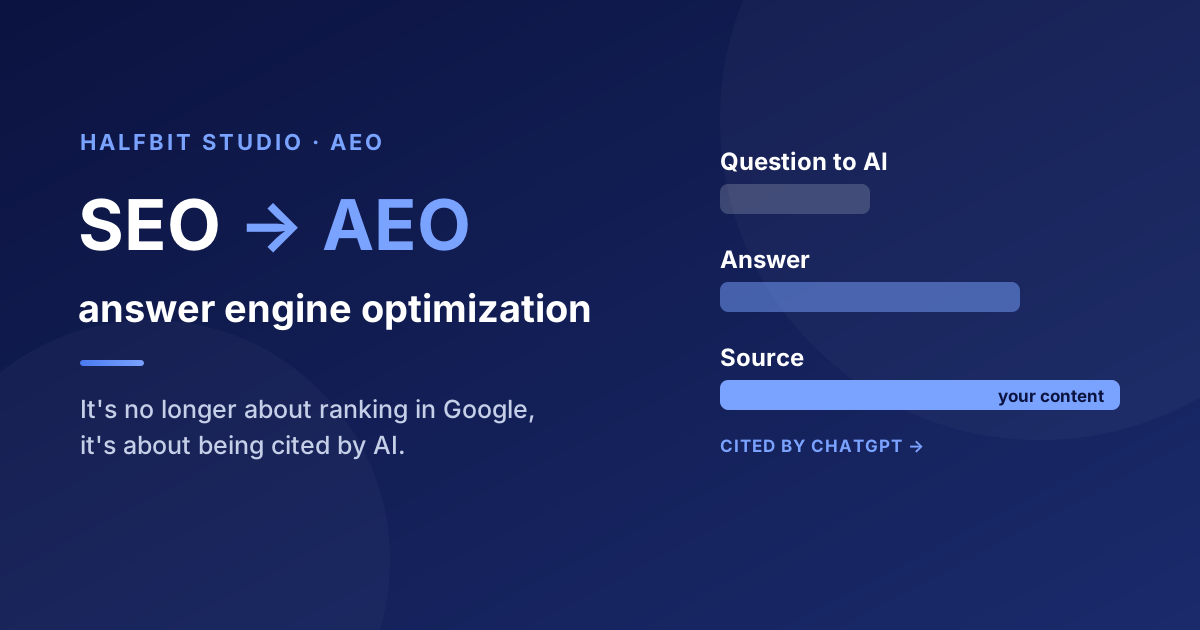
More and more people don't "google" anything – they ask ChatGPT or Perplexity, and Google answers in the results before anyone clicks. The "be number 1, capture the traffic" model is slowly breaking down. This isn't another "SEO is dead" clickbait. It's a practical piece about AEO – optimizing for answer engines – and about how to not just get cited by someone else's AI, but also build your own answer engine on your own data.
What's in this article?
- Is SEO really dying?
- What is AEO (Answer Engine Optimization)?
- SEO vs AEO – what really differs?
- How to prepare content so AI cites you?
- One step further: build your own answer engine
- How we do it ourselves?
- Frequently asked questions (FAQ)
1. Is SEO really dying?
The headline "SEO is dying" is clickbait. What's dying is something narrower but very concrete: the model where you were in position 1, someone clicked, landed on your page and closed the matter there. That mechanism is falling apart for three reasons at once:
- Zero-click searches. According to SparkToro research, a large majority of Google searches end without a click on any result – the answer is already in the result itself (AI Overview, panel, snippet). You rank high, but the traffic isn't there.
- People ask AI, not a search engine. ChatGPT, Perplexity, Claude and Copilot have become the default place many people ask a question – instead of skimming ten blue links.
- Content saturation. When everyone publishes the same 10,000-word guide, the seventh result on the list simply doesn't exist.
The effect is counterintuitive: rankings can stay put while traffic still drops. What changed isn't how search engines rank pages, but how people use them. A ranking without a click is visibility without a visit – and without a transaction.
2. What is AEO (Answer Engine Optimization)?
AEO, or Answer Engine Optimization, is optimizing content for answer engines: ChatGPT, Perplexity, Claude, Copilot and Google AI Overviews. The goal is no longer a click to your page, but for the model to read, understand and cite your content as the source of the answer.
Imagine someone asks ChatGPT: "custom system or off-the-shelf SaaS – which for a small company?". If your article is well phrased, the model summarizes the arguments and points to you as the source. The visitor may never see your page – but you gain authority and reach someone who just made a buying decision based on your arguments.
The difference is fundamental. SEO optimizes for an indexing algorithm that selects and ranks pages. AEO optimizes for a language model that interprets, synthesizes and cites. It's a different mechanic, a different content structure and a different definition of success.
3. SEO vs AEO – what really differs?
| Dimension | SEO | AEO |
|---|---|---|
| Goal | High position in results | Citation in an AI answer |
| Success metric | Click to the page, CTR, sessions | Source mention, brand in answers |
| You optimize for | Indexing algorithm | Language model |
| Content format | Long-form for keywords | Question → answer → proof |
| Trust signals | Backlinks | Consistent entity, structured data, citations |
| Freshness | Soft signal | Hard signal (model cut-off date) |
| Role of the page | The user's destination | A data source for the model |
In short: in SEO the page is the place you want to lead someone to. In AEO the page is the source the model draws from – and points at you along the way.
4. How to prepare content so AI cites you?
No magic – it's a set of concrete habits that also raise content quality for humans anyway:
- Answer up front. The model splits content into fragments. If the point comes after eight hundred words of runway, that fragment won't make it into the generated answer. Put the substance in the first paragraph.
- Question → answer → proof structure. Headings as real questions, FAQ sections, and under them a concise answer plus a concrete: data, an example, a number.
- Structured data (Schema.org / JSON-LD). Organization, Article, FAQPage, BreadcrumbList – for the model, that's the page's table of contents. Without it, content is like a book with no contents: readable, harder to cite.
- A consistent entity across the web. The same name, description and company data in your Google profile, on LinkedIn, in directories and publications. The model must recognize you unambiguously, not guess whether it's the same company.
- Freshness. Publication and update dates are a hard signal when sources are picked. Twenty current, maintained articles beat two hundred from 2021.
- Machine-readable content. Clean HTML, tables and charts with captions, plus a
/llms.txtfile – a simple, Markdown map of the site for LLM agents and crawlers (the llmstxt.org convention). - Measure differently. Not just rankings and CTR. Ask the models about your domain, check whether and how they cite you, track brand mentions in AI answers.
This is familiar ground for software houses: documentation, knowledge bases and help centers suddenly become a critical asset, because that's where AI draws answers cited in customers' decisions. Sorting that out is part of our work on AI implementations and process automation.
5. One step further: build your own answer engine
AEO has one limitation: you optimize for someone else's AI. OpenAI, Google or Perplexity set the rules and you tune to them. There is, however, a move that gives you control – your own answer engine.
It's an assistant or chatbot running on your knowledge: documentation, knowledge base, ticket history. It answers your customers with your data, on your site, by your rules – and no change to someone else's algorithm takes that away. It's exactly the same building block we used for our multi-agent AI Helpdesk – a system that analyses questions, reaches for company data and drafts answers, handing uncertain cases to a human.
The best part is that both routes use the same work. A well-structured, current knowledge base simultaneously:
- feeds AEO – other models cite an ordered, unambiguous source more readily,
- feeds your own engine – your chatbot answers customers based on it.
One investment in content and structure, two returns. We described more about how such systems work under the hood in the anatomy of a production multi-agent system.
6. How we do it ourselves?
We're not writing this as theorists. This blog is built exactly by the AEO rules:
- every post emits JSON-LD structured data (Organization, BlogPosting, BreadcrumbList),
- the text has a question–answer structure and FAQ sections,
- we keep publication and update dates as a freshness signal,
- and the whole site exposes a /llms.txt file – a machine-readable map of the offering for models and agents.
We do it not because it's trendy, but because we build AI systems and we know how models read content. Over the coming years AEO will stop being an advantage and become the standard – companies that start now will build authority that's hard to catch up with. We take the same approach to where AI actually pays off in our piece on AI in business.
Frequently asked questions (FAQ)
Did SEO die in 2026?
Not entirely – what's dying is the "be at position 1, capture the click" model, because a large majority of searches end without a click. Classic SEO still organizes content and helps models find it, but the fight is moving to a citation in AI answers (AI Overviews, ChatGPT, Perplexity) – and that's AEO.
What is AEO (Answer Engine Optimization)?
It's optimizing content for AI answer engines. Instead of fighting for a click from a results list, you fight to have the model cite your content as a source. The page stops being a destination and becomes a data source for the model.
How is AEO different from classic SEO?
SEO optimizes for an indexing algorithm and measures success by clicks and position. AEO optimizes for a language model that interprets and cites content, and success is a source mention in an answer. Different signals (structured data, a consistent entity, freshness instead of just links) and a different format (question → answer → proof).
How do I check whether AI cites me?
The simplest way: ask the models (ChatGPT, Perplexity, Google AI Overviews) questions from your domain and check whether your brand or content appears as a source. Worth doing regularly and tracking brand mentions – it's the new equivalent of rank monitoring.
Does AEO replace SEO or complement it?
It complements it and shifts the center of gravity. Good structured data, a clear entity and content that answers questions help both in search and in answer engines. One step further is your own answer engine – a chatbot on your data that a change to someone else's algorithm won't touch.
A world where AI answers instead of a search engine doesn't mean the end of content – it means different content: ordered, unambiguous and machine-readable. If you want to prepare your company for AEO or go a step further and build your own answer engine on your data, take a look at our AI Helpdesk project, check out AI implementations or simply get in touch.