

HackNation 2026 – Poland's largest in-person implementation hackathon – took place on November 21–22 in Bydgoszcz. We competed as team HalfMinions and won the “Kompas kompetencji” (Competency Compass) challenge set by the Ministry of Digital Affairs. In 24 hours we built Busola Rozwoju (“Development Compass”) – an app that guides people through employee appraisals in the Polish civil service, step by step. Below are the key facts about the event, the challenge and what exactly we built.
What's in this article?
- What is HackNation?
- HackNation 2026 in numbers
- The Ministry of Digital Affairs' “Kompas kompetencji” challenge
- Team HalfMinions
- Busola Rozwoju – what we built in 24 hours
- AI that suggests but doesn't decide
- Technology and architecture
- What's next?
- HackNation 2026 – frequently asked questions (FAQ)
1. What is HackNation?
HackNation is an implementation hackathon run by the Polish public administration: the GovTech Polska Department at the Ministry of Digital Affairs, together with the City of Bydgoszcz. The format is simple – public institutions bring real problems, and interdisciplinary teams get 24 hours to build a working solution. “Implementation” is not just a label: according to the organizers, the first projects from the 2025 edition are already in the final stretch of being rolled out in the administration.
The second edition took place on November 21–22, 2026 at the Bydgoszcz Fair and Exhibition Centre. You can read more about the event on the official website, hacknation.pl.
2. HackNation 2026 in numbers
Figures from the organizers' closing press release:
- about 2,000 participants and 600 submitted projects (a year earlier: about 1,500 people and 437 solutions),
- 15 challenges prepared by 14 partners – including the Ministry of Digital Affairs, NASK, ZUS (Social Insurance Institution), the Polish Financial Supervision Authority, the National Revenue Administration, the Ministry of Foreign Affairs and the Chancellery of the Prime Minister,
- over 200 mentors supporting the teams,
- 24 hours of coding – from Saturday 11:00 to Sunday 11:00,
- total prize pool: over PLN 370,000.
In each of the 15 challenges, one team took the main prize. In “Kompas kompetencji” it was ours – HalfMinions.
3. The Ministry of Digital Affairs' “Kompas kompetencji” challenge
The challenge came from the Office of the Director General of the Ministry of Digital Affairs. The starting point: choosing the right criteria, assessing competencies fairly and talking about work results are real challenges for supervisors in the civil service, and among procedures and forms it is easy to lose sight of the goal of the whole process – supporting the employee's further development. The question was: how can technology make objective assessment easier and create room for a conversation about achievements, areas for improvement and next career steps?
Before we wrote the first line of code, we read the regulations. Appraisals in the Polish civil service – the first appraisal and the periodic one – are governed by an act, two regulations and official guides: over 90 pages that supervisors and HR need to know to run the process correctly. Hence our idea: don't replace the process, take the regulations off people's shoulders so they can focus on the conversation.
4. Team HalfMinions
HalfMinions is the Halfbit team together with Jakub Grzeszczyk of PixelSystem. The line-up:
- Marcin Golonka,
- Katarzyna Mularczyk,
- Adam Gajewski,
- Tobiasz Młynarczyk,
- Maciej Siedlecki,
- Jakub Grzeszczyk of PixelSystem.
Day to day, Jakub runs PixelSystem, where he builds modern web applications in React, Next.js and TypeScript. Jakub – thanks for those 24 hours together!
For us this closes a hackathon autumn: in October Marcin was a mentor at HackYeah 2026 in Kraków, and in November we stood on the other side – as participants.
5. Busola Rozwoju – what we built in 24 hours

Busola Rozwoju helps run employee appraisals in the civil service – the first appraisal and the periodic appraisal. The project's tagline: “Different roles, one compass. Together towards development.” Key features:
- Separate views for every role – employee, supervisor, HR and administrator – each with permissions limited to their own scope.
- A step-by-step appraisal that follows the official sheet templates: the first appraisal and the periodic appraisal (sheets B and C) with criteria, indicators and partial ratings phrased as behavioural questions.
- Employee self-assessment and supervisor's observation notes – with a hint to describe facts, not opinions.
- Deadlines calculated from the regulations, including public holidays. They shift with absences, and every change stays in the history.
- “Check before signing” – a list of gaps in the sheet, each pointing to a specific paragraph.
- Handwritten signature on a phone via a QR code, and a PDF sheet that matches the official template.
- A rules assistant that answers questions about procedures and always cites its source.
- A “needs attention” dashboard, reminders, organizational structure, two-factor login and an audit log.
6. AI that suggests but doesn't decide
In public administration, trust in the system matters more than a “wow” effect, so we drew a line from the start: AI suggests, the supervisor gives the rating. The assistant is available on every screen and answers only from a knowledge base of regulations – the Civil Service Act, two regulations and the Chancellery's guides. Every claim has a basis: the act and the paragraph, and citations that are not in the source material are flagged with a warning.
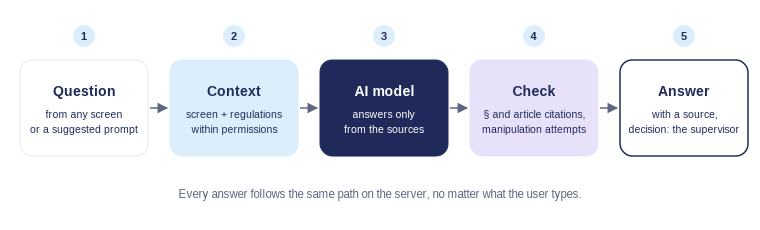
- Semantic search – the right paragraph is found even when someone asks in their own words.
- Screen context – the assistant knows which appraisal you are looking at, but sees only the data the logged-in person can see.
- On-screen guidance – instead of describing “click here, then there”, the assistant highlights, one by one, what the user needs.
- No guessing – when the material doesn't answer the question, the assistant says so plainly and points to HR.
Just as important is where AI is deliberately absent. Everything with legal consequences – deadlines, the suggested appraisal result, permissions – is computed by rules written in code, not by the model. The result is repeatable and can be checked against the regulation. We take the same approach to AI implementations for our clients: a model where it helps, hard rules where accountability matters.
7. Technology and architecture
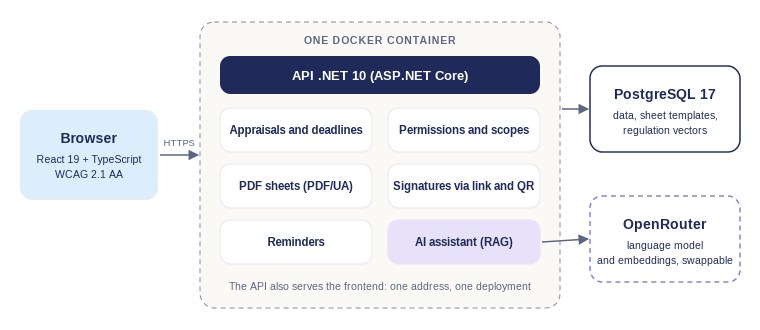
- Interface: React 19, TypeScript, Vite – designed with WCAG 2.1 AA in mind.
- Server: .NET 10 (ASP.NET Core), ASP.NET Identity and JWT – roles, permissions and data scopes enforced on the server.
- Database: PostgreSQL 17 and Entity Framework Core.
- Documents: QuestPDF – appraisal sheets in PDF/UA, print-ready and readable by screen readers.
- AI: a language model and embeddings through OpenRouter – the model and provider are changed in configuration, including to a model hosted in the EU or locally.
- Deployment: a single Docker image – the same one in the cloud and on an office's own server.
Two decisions proved crucial within 24 hours. First, a modular monolith: one application, one deployment, one database – without the cost of distributed infrastructure. Second, sheets as data: a sheet template (fields, stages, deadlines, scoring) is a versioned template in the database, so a change in regulations needs no programming and appraisals in progress stay on their version. We used Claude Code for writing code, reviewing changes and documentation – every change was approved by a human.
8. What's next?
According to the organizers, the winning solutions have a chance of further development and implementation together with the institutions that posted the challenges. Busola has a ready list of next steps: qualified electronic signature, single sign-on through the office's directory, import from the HR system and e-mail notifications.
A hackathon prototype proves the idea makes sense – and the road from a prototype to a system you can trust in production is our everyday work. At Halfbit we design and build custom software, implement AI – like our AI Helpdesk – and help choose the right architecture as part of IT consulting.
9. HackNation 2026 – frequently asked questions (FAQ)
When and where did HackNation 2026 take place?
HackNation 2026 took place on November 21–22, 2026 at the Bydgoszcz Fair and Exhibition Centre in Bydgoszcz, Poland.
Who organizes HackNation?
The GovTech Polska Department at Poland's Ministry of Digital Affairs, together with the City of Bydgoszcz.
How many people took part in HackNation 2026?
According to the organizers, about 2,000 people, who submitted 600 projects across 15 challenges prepared by 14 partners.
Who won the “Kompas kompetencji” challenge?
Team HalfMinions – the Halfbit team with Jakub Grzeszczyk of PixelSystem – with the Busola Rozwoju project.
What is Busola Rozwoju?
It is an app that guides the employee, the supervisor and HR through the first and the periodic appraisal in the Polish civil service: it keeps track of deadlines and sheet templates, while an AI assistant answers questions about the regulations, always citing its source.
Does AI give the rating in Busola Rozwoju?
No. AI suggests and searches the regulations, and the rating is always given by the supervisor. Deadlines, scoring and permissions are computed by rules written in code, not by the model.
Thank you to the organizers, mentors and jury for a superbly prepared event, and congratulations to the other teams. And if you have a process – in a public office or in a company – that you'd like to put in order with AI and well-designed software, let's talk.